Recently I have been spending time on a magnetometer based smart water meter for Home Assistant. The idea is simple: strap two magnetometer sensors (QMC5883L) onto a residential water meter, read the rotating magnetic field, and count water flow. What actually happened was a 10 nights debugging odyssey that taught me about multi-pole magnets, quadrature encoding, and the joy of writing actual C++ for ESPHome.
This project is a fork of tronikos/esphome-magnetometer-water-gas-meter, which already does single-sensor flow counting with a calibration UI. I was using this initially on my meter, for what it advertises, it worked pretty well. But ever since I heard about the benefits of quadrature encoding from espleak. I couldn't help want to upgrade to it. It was scheduled since last September but procrastination beat me so hard on this one.
What benefits though compared to a single sensor? Keep reading.
How residential water meter works.
Understanding how meter works is very important, there is an excellent YouTube video about this:
Mine happened to be a Badger Meter as well. What matters here is that inside the chamber there is a magnet wheel, driven by the nutating disk beneath it. As the disk nutates, it spins the magnet wheel, which produces a multi-pole magnetic field. This rotating field is what causes the register mounted on top to advance its readings — essentially translating the mechanical motion of water flow into the numbers you see on your meter face.
In principle, we use the magnetometer sensors (QMC5883L) that function the same as the register (the city gives to us), when we detect a magnetic field change similar to a sin wave, we count certain volume pass through the meter. That is the physics foundation of the project (also used by tronikos/esphome-magnetometer-water-gas-meter).
How quadrature encoding improves for us?
As you can probably guess, with a single sensor, we can only count how many the pole change event happened, what quadrature encoder helps is that it can also give us the direction by using 2 sensors with phase shift, essentially 2 sensors will produce sin/cos waves where you can decode into direction. This will give bidirectional counting — knowing not just that water flows, but which direction. Why would you care directions? Isn't that you would only consume water from the city? That is true, you will see later why we need direction as well.
Looks straightforward — so let’s get started.
ESPHome with Actual C++ code
both tronikos/esphome-magnetometer-water-gas-meter and espleak just encoding the ESP32 C++ code in YAML config file directly. Well, I really do not like writing C++ source code in YAML. The tronikos project, like most ESPHome configs, puts all the logic inside lambda: blocks. This works, but you lose syntax highlighting, proper compilation errors, and any semblance of code organization once your logic exceeds 20 lines.
ESPHome gives you two escape hatches here. The first is includes:, where you list .h and .cpp files that get copied into the platformio build:
esphome:
  includes:
    - sensor_update.h
    - sensor_update.cpp
This works great locally with esphome compile, but falls apart on Home Assistant's ESPHome builder because paths get expanded to absolute during the YAML fusion step. /config/esphome/sensor_update.h is where it ends up looking, and of course your files aren't there if you are using packages.
The 2nd approach is external components, which is what I ended up using:
components/
  sensor_update/
     __init__.py
     sensor_update.cpp
     sensor_update.h
     sensor_update_component.h  # empty component
The trick is that platformio automatically compiles all C++ files under your component directory. The sensor_update_component.h is a dummy — ESPHome's component system requires it, but the actual logic lives in sensor_update.cpp and gets called from a thin lambda in the YAML. For deployment to Home Assistant, you switch the source from type: local to type: git and point it at your repo. Problem solved.
Quadrature encoding 101
The quadrature encoder works by placing 2 QMC5883l sensors offset by 90 degrees, so that one produces sin(t) and the other cos(t). Each sensor's reading is thresholded with hysteresis to a boolean (high/low), and the two Boolean's are combined into a 2-bit state: s0 + s1 << 1, giving states 0 through 3:
 cw:  0 → 1 → 3 → 2 → 0
ccw:  0 → 2 → 3 → 1 → 0
This is the standard Gray-code sequence from the SparkFun quadrature encoder guide. Direction is looked up from a 4x4 table indexed by qdec[prev * 4 + curr]:
static const int qdec[16] = {
   0,  1, -1,  2,
  -1,  0,  2,  1,
   1,  2,  0, -1,
   2, -1,  1,  0
};
Where 0 means no transition, 1 is clockwise, -1 counter-clockwise, and 2 would be an illegal double-transition, when this happens it means that both sensor changed the state between 2 samples, that sensor is updating way too fast it causes "aliasing".
However, the value 2 is actually unreachable for us, this is the specialty of a hardware quadrature encoder, where it can sample both sensors at the same time. For us software based implementation, sensor_update() is called once per sensor reading via on_raw_value, so only one sensor can cross a threshold per call. The other sensor's bit is unchanged, guaranteeing single-bit transitions.
When sensor_update(s, v) fires, sensor 1-s has not transitioned, so q[1-s] is simultaneously its previous and current state:
int curr = (q[sensor] << sensor)  + (q[1-sensor] << (1-sensor));
int prev = (qlast << sensor)      + (q[1-sensor] << (1-sensor));
int mod  = qdec[prev * 4 + curr];
Why direction matters
Does this mean the quadrature meter useless to us? Not really. As you may recall, as residential user, we would normally just consume, not producing water, so we should always get 1 during sampling. But in reality, negative direction can still happen for us during a pipe burst (which is second last thing you want to happen in your house), the magnet spin so fast that it will jump stats, for example, it will go from 0->1, then skip 3 and 2 and goes directly to 1-> 0. Reflected on the sensor is that we have a negative direction.
From analog signal to binary signal
With that in mind, I started the experimentation setup, 3D printed a spinning wheel with 2 magnet attached to it and wiring up my ESP32 with QMC5883ls offset by 90 degrees and started debugging. The first thing I need to deal with is the hysteresis sampling. Why? It would be nice if we get perfect sin/cos wave from the meter but in reality we get a very noisy signals, in the end we will want to get a somewhat clean box wave to represent 0 and 1s, which our software developers are familiar with. There are multiple way doing this, people in electrical engineering dealt with this long time ago through schmitt trigger (which is quite elegant and efficient). Here we use tare + hysteresis to produce box waves.
Without going too much into details, the logic is basically (But again, I would like to point out this potentially 8 CPU instructions can be implemented by a simple circuits).
float tare       = (tmax + tmin) / 2.0f;
float hysteresis = (tmax - tmin) * 0.2f;
bool  high       = signal > tare + hysteresis;
bool  low        = signal < tare + hysteresis;
Hysteresis side effects
The hysteresis thresholding has a surprising inertia effect worth noting. For a perfect sin/cos wave, you want the state to toggle at zero-crossings. But with hysteresis, the state only changes at [tare - hysteresis, tare + hysteresis]. If you are rotating in one direction, both sensors are lagging by 2 * hysteresis — this is just a constant phase shift, no problem.
But if you suddenly reverse direction, you feel the lag: the state has to travel back through the full hysteresis band before it flips. In practice this means a few quarter-rotations of "dead zone" on direction reversals. For a water meter this is fine — water doesn't usually reverse direction rapidly.
The 4-pole magnet surprise
Once I did the experimentation on the test setup, confirm that I can get consistent direction reading when I rotate the magnets, time to move to the real thing.
Here is where things got interesting. I mounted two QMC5883L sensors at 90 degrees physical separation on a Badger Model 25 water meter, ran some water, and got garbage. The state transitions were chattered — random CW/CCW with net zero movement. The serial log looked like this:
sensor 0 at 755414, (49.59, -28.82, 77.47) => (0, 1 -> 1)
sensor 1 at 755626, (-12.05, -93.19, 17.02) => (1, 3 -> 1)
sensor 0 at 755633, (-3.40, -28.80, 77.44) => (3, 2 -> 1)
sensor 0 at 755925, (48.02, -29.42, 76.97) => (2, 3 -> -1)
sensor 1 at 755939, (-62.28, -93.16, 16.99) => (3, 1 -> -1)
sensor 0 at 756146, (0.64, -29.40, 76.94) => (1, 0 -> -1)
sensor 1 at 756165, (0.28, -93.14, 16.97) => (0, 2 -> -1)
sensor 1 at 756452, (-62.65, -93.11, 16.94) => (2, 0 -> 1)
sensor 0 at 756456, (49.22, -29.37, 76.91) => (0, 1 -> 1)
sensor 1 at 756665, (-13.34, -93.09, 16.92) => (1, 3 -> 1)
sensor 0 at 756677, (-3.04, -29.35, 76.89) => (3, 2 -> 1)
sensor 0 at 756963, (48.02, -29.33, 76.86) => (2, 3 -> -1)
Directions flipping back and forth within milliseconds. Something was fundamentally wrong with the phase relationship.
I added CSV logging to dump the raw field strength from both sensors, and the plot told me a very different story.
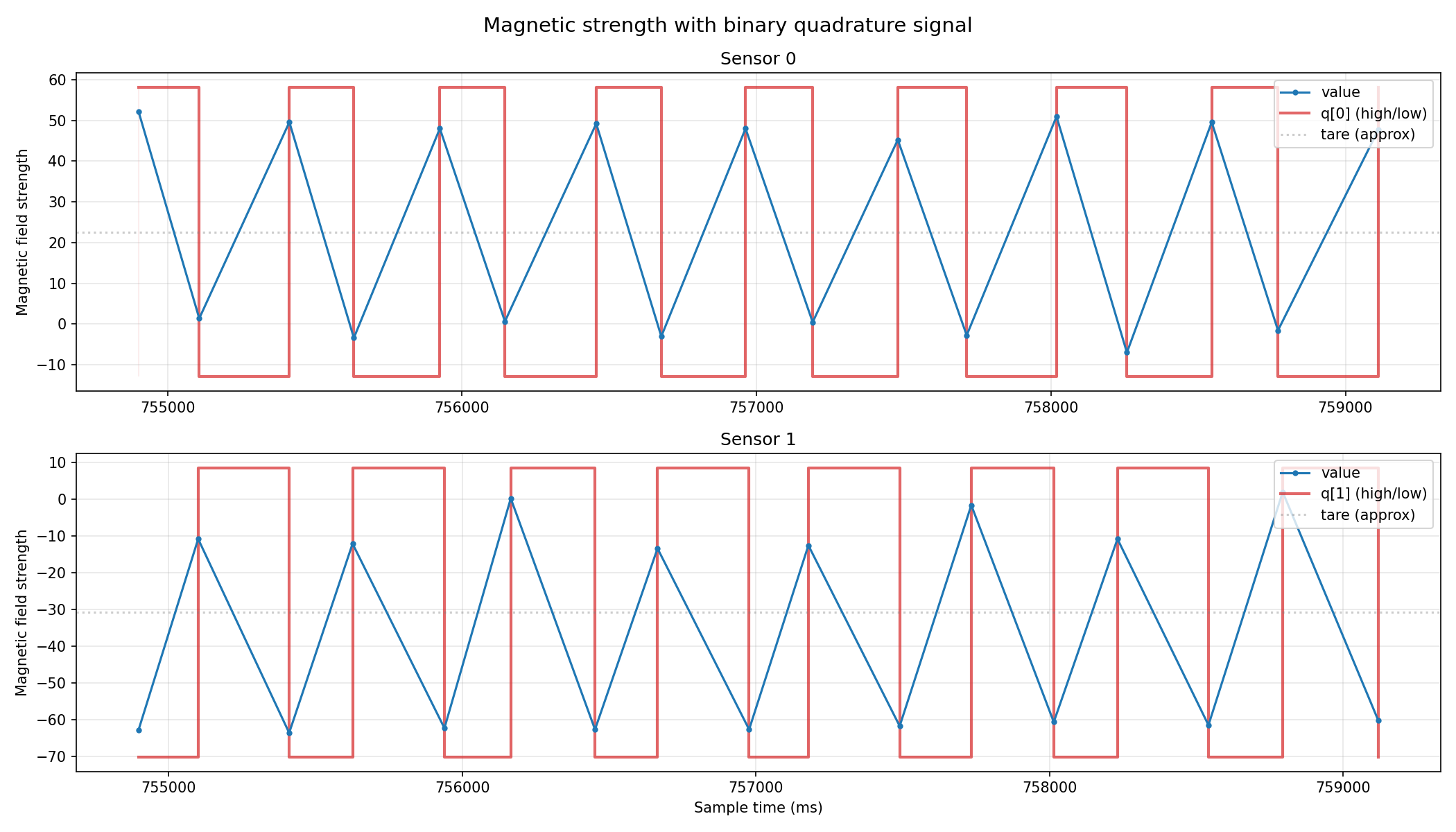
When sensor 0 peaked, sensor 1 troughed, and vice versa. That is 180 degrees — anti-phase, not the 90 degrees needed for quadrature. Both sensors cross their thresholds at nearly the same time. Which one crosses "first" depends on noise and sampling jitter, so the decoder sees random CW/CCW. Initially I was still in doubt where is the bug in my code until I use an LEDs to help me confirm the behavior.
The culprit: the meter has a 4-pole magnet inside the register and my test setup uses only 2 magnets. Multi-pole magnets are common in residential water meters for higher pulse resolution and stronger near-field coupling.
The solution is then moving the second sensor to approximately 45 degrees, finger crossed and turned on the water tap.
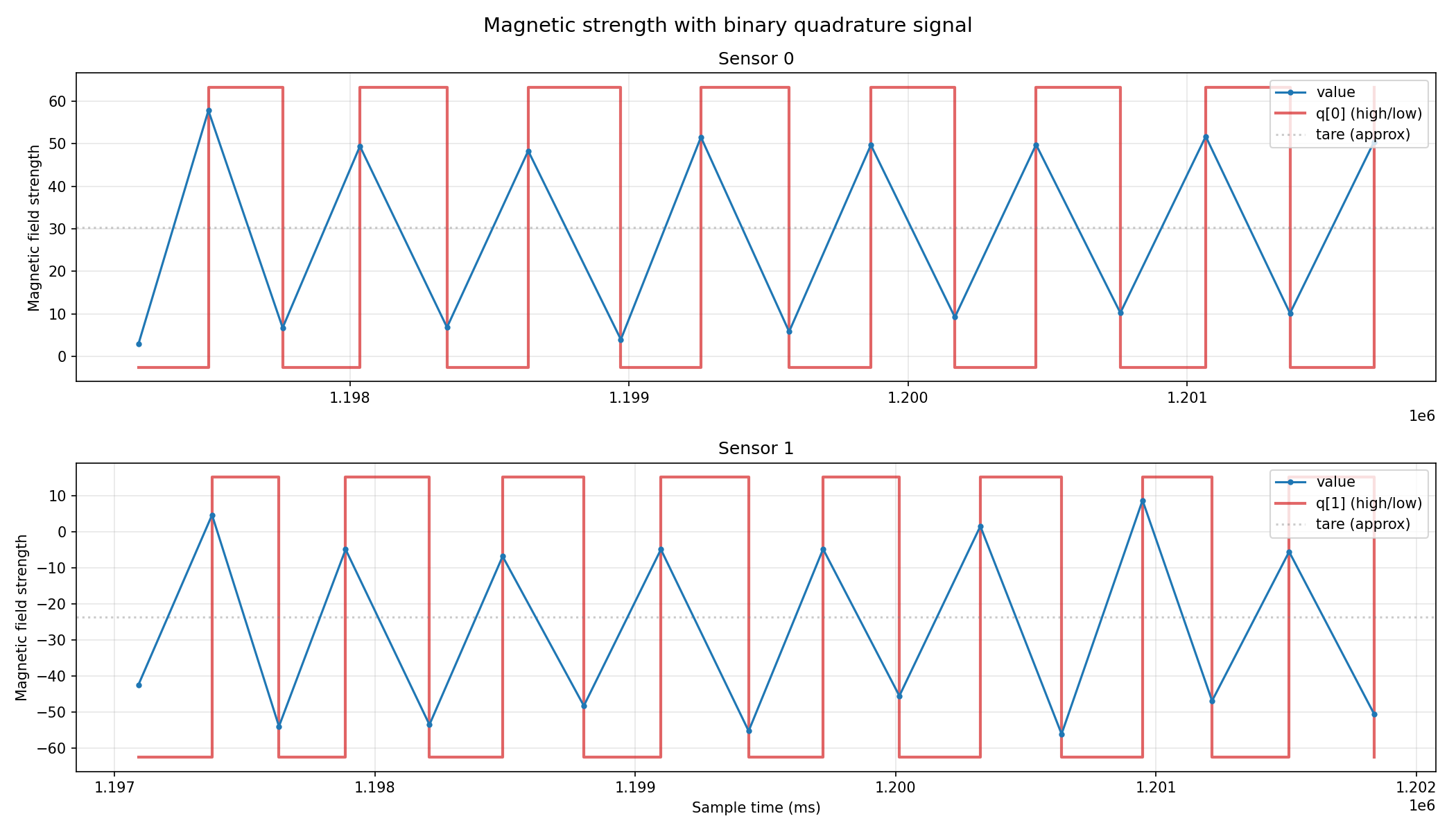
Ah ha, it is working in real-life!
And then after is of course the boring software part of deal, creating template sensors in esphome, computing volumes based on rotations, etc. The state of the project is at xeechou/esphome-magnetometer-water-gas-meter on the quadrature-meter branch if you are interested.
What I learned so far?
Programming for micro-controllers is much more different than pure software development really. This is some C++ code running at 200kHz on a chip with only 4Mb memory, every-time we make changes in the code, we need to flash to the chip to test out. (Same story is true for GPU shaders, but drivers insulate us too well for this).
Debugging is very non-trivial either. You can't simply step through the code to figure out your mistakes, we need real world magnet field readings. Logging is not a reliable way either, the chips are very weak can easily throttled in this way.
Did AI help here?
Yes, quite a lot actually. Pair programming with AI eased a lot of the boilerplate code, especially in the beginning. For side gigs like this project, without AI to increase the velocity, I might simply give up or procrastinate much longer.
It is not, however, very good for debugging — though it does help to some extent. For this project specifically, the debugging was quite tricky. We needed a special setup, both in code and physically, to debug effectively. It wasn't simply a matter of run-and-log with a quick feedback loop back to the AI system.
Note that if you yourself don't have the insight, AI can easily mislead you down the wrong path. I fell into this trap quite a few times during this project. Having a strong foundation and a proven setup is a necessity.
future works
This project is not complete either. The flow monitoring and leak trigger is not setup yet. There are also some unanswered question I have but it is to a state where I can leave it for running for a while. Have fun.
Reference
- tronikos/esphome-magnetometer-water-gas-meter — the original single-sensor project this was forked from.
- dnschneid/espleak — flow monitoring and leak detection implementation that inspired the burstmon and upcoming flowmon features.
- SparkFun: How to use a quadrature encoder (PDF) — the Gray-code lookup table reference.